Comparison
Open source alternative to Claude Cowork
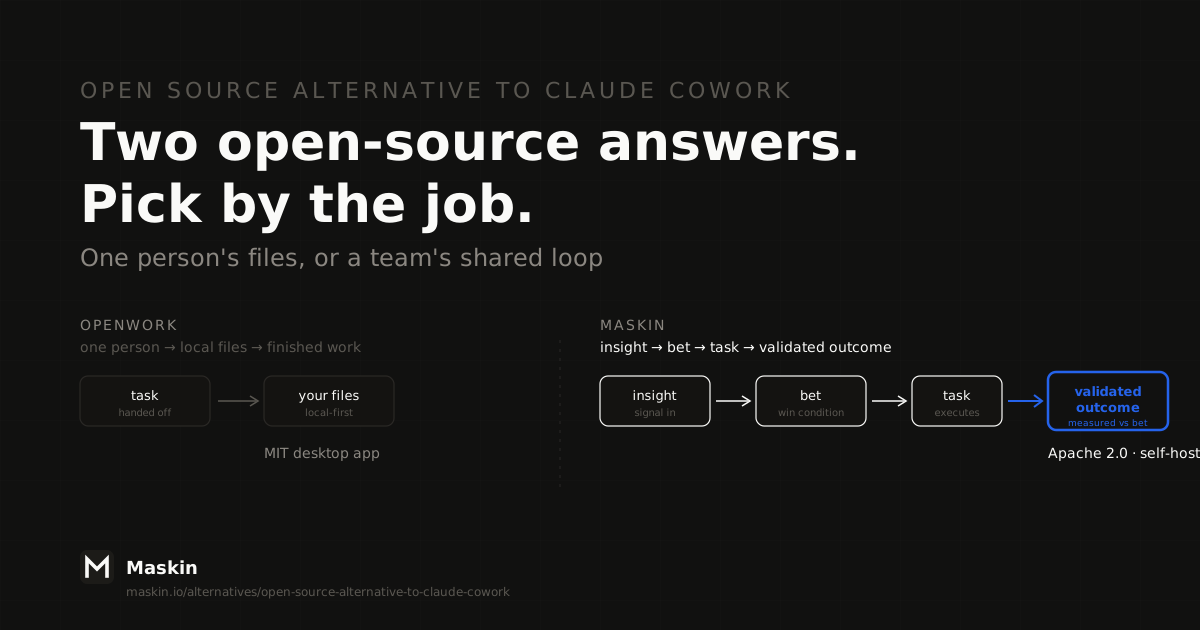
The closest open-source alternative to Claude Cowork depends on the job. OpenWork is the nearest match if you want one person's agent working on local files. Maskin, which is Apache 2.0 and self-hostable, is the open-source answer if a team needs agents working on shared records of insights, bets, and tasks.
Looking for a project tracker instead? See the Open source Jira alternative.
- Claude Cowork is a knowledge-work agent, not a coding tool. Anthropic describes it as a system you give a goal, which then “works across your files and tools” and returns “polished work for your review.” The open-source alternatives that fit that job are desktop agents, not trackers.
- Two different open-source answers. OpenWork is the personal-desktop answer (MIT-licensed app, local-first, 50+ model providers or local models). Maskin is the team-workspace answer (shared object model, closed loop from signal to validated outcome).
- Maskin is Apache 2.0 and free to self-host. Agent sessions run the Claude Code CLI by default, or the Codex CLI, so you also pay for the model usage behind them. Managed plans are listed in the Maskin pricing section.
- Maskin does not replace a desktop agent on your files. If your day is spreadsheets, contract reviews, and folders of documents handled by one person, start with OpenWork.
- Maskin is early. The public repo has 6 GitHub stars and 398 open issues and pull requests (GitHub API, 1 October 2026). Judge the architecture, not a track record.
Which open-source alternative fits your job?
Most pages ranking for this query are lists of tools that all answer a slightly different question. Sorting by what you need is faster:
| If you need | Closest open-source fit | Why |
|---|---|---|
| One person's agent working on local files and documents | OpenWork | Desktop app for macOS, Windows, and Linux, local-first, bring your own keys or local models |
| A team's agents working on shared product records, self-hosted | Maskin | Typed objects (insight, bet, task) shared by humans and agents, MCP-native, Apache 2.0 |
| An open-source project tracker | See the Jira alternative page | A different search intent, with a different comparison set |
| AI employees with an org chart | See the Paperclip alternative page | Orchestrator-style tools, a different shape of problem |
What Claude Cowork actually is
Claude Cowork is Anthropic's autonomous task product. Per Anthropic's own product page, you give it a goal and it works across your files and tools, breaks larger projects into parallel workflows, runs tasks unattended, and hands back finished work for review. The examples Anthropic leads with are weekly reports, spreadsheet reconciliation, bulk contract review, and call-note analysis. It runs as a desktop app on macOS, Windows, ChromeOS, and Linux, has a built-in browser for web tasks, and is available on Pro, Max, and Team plans at the time of writing, with Enterprise admins managing it in organization settings.
That is a good product, and it is worth saying so before arguing for anything else. The unit of work is a task someone hands off and reviews, and for a lot of people and teams, that is exactly right.
Where teams outgrow it
Three limits show up when the reason for looking at an alternative is control, not features.
The model and the hosting are the vendor's. Cowork runs on Claude inside Anthropic's product, and Anthropic does not publish Claude's weights, so you cannot run Cowork end to end on your own infrastructure. If self-hosting is the constraint, you need an open-source platform you can run yourself.
The work lives in a task, not in a shared product record. A task you hand off and review is a good unit for delegated work, even on a Team plan. A team deciding what to build needs something else: the signal that started the work, the decision to pursue it, who owns it, and whether it worked. That is a shared object model, and a task queue does not give you one.
You cannot inspect or host the loop. If a governance or compliance rule requires the system to run inside your boundary, a closed product cannot meet it. Open source plus self-hosting is the structural answer.
Sebastian Krumhausen's April 2026 post on the agent-workspace market names the position Maskin sits in: composable infrastructure, built from typed objects, event-driven triggers, and small auditable agents, as opposed to a simulated company of AI employees. A self-hostable, open-source answer belongs in that camp.
What OpenWork does well
OpenWork is the open-source project that most directly targets the same search. Its README calls it “the free, open-source alternative to Claude Cowork and Codex: a desktop app for macOS, Windows, and Linux where AI agents do real work on your own files.” The desktop app and core are MIT-licensed. It is local-first (“Your files stay local. Cloud is optional.”), supports 50+ providers, your own API keys, or local models via Ollama, and has an organizational control plane (OpenWork Den) under a separate enterprise license that is free for up to 5 users.
Be clear about what that means. If you want Cowork's experience (an agent on your files, producing documents and finished work) without Anthropic's lock-in, OpenWork is the closer match than Maskin. We would rather say that here than have you find out after installing the wrong one.
Where Maskin fits, and where it doesn't
Maskin is a team workspace that agents write into. It is not a desktop agent that works through your Downloads folder.
In Maskin, work enters as an insight from Slack, Intercom, PostHog, GitHub, Gmail, or a scheduled scan. Someone shapes it into a bet, a testable hypothesis with a win condition, owned jointly by a human and agents. The bet breaks into tasks, which agents execute in isolated, sandboxed sessions (the Claude Code CLI by default, or the Codex CLI, each inside an ephemeral microVM built on microsandbox and libkrun, with a browser sidecar for web work). When the work ships, the outcome is checked against the win condition and the requester is notified. Insights, bets, and tasks are all objects in one schema, connected by typed relationships, and served identically to the UI and to agents. That shared object model is what carries a decision across sessions and hands it between a human and an agent. The full walk-through is on the agentic-workspace explainer.
Three honest limits:
- Not a personal-files agent. Maskin works on shared records and connected tools, not on a folder on one laptop.
- Cross-conversation agent memory is a known gap. Our own user feedback says other agent products handle this better, so do not pick Maskin for a single agent that remembers everything about you.
- A hard host requirement for agent sessions. Self-hosting means running the microsandbox and libkrun runtime on the agent-server host. Docker is used only for local development, and there is no fallback that runs agents without one of the two.
Maskin also operates a level above the editor and repo. For where that line sits, see AI product workspace vs AI coding agent and the broader three tiers of AI-native work.
Maskin vs Claude Cowork vs OpenWork
| Maskin | Claude Cowork | OpenWork | |
|---|---|---|---|
| What it is | Team workspace for product work | Autonomous task agent for knowledge work | Desktop agent on your own files |
| Open source | Yes, Apache 2.0 | No | Yes, MIT desktop app and core (enterprise control plane under a separate license) |
| Self-host | Yes, free | No | Runs locally on your machine |
| Models | Claude Code CLI by default, or Codex CLI | Claude | 50+ providers, your own keys, or local models |
| Unit of work | Shared typed objects: insight, bet, task | A task you hand off and review | Agent sessions on your files |
| Built for | Teams | Professionals and teams (Pro, Max, and Team plans) | Individuals, with an org control plane |
| Weak spot | Not a personal-files agent, memory gap, early traction | Vendor model and hosting | Not a shared team record |
Self-host or managed
Maskin is Apache 2.0, so the choice is yours.
| Self-hosted | Managed | |
|---|---|---|
| License | Apache 2.0 | Apache 2.0 software plus a hosted service |
| Cost | Software is free. You pay for the model usage behind your agents. | See the pricing section for current plans |
| You operate | The infrastructure, including the agent-server host and its microVM runtime | Nothing |
| Good for | Teams that need the loop inside their own boundary | Teams that want the loop without running it |
Getting started
- Self-host. Clone the repo (github.com/sindre-ai/maskin) and follow the onboarding. You need a host that can run the microsandbox and libkrun runtime for agent sessions. The self-hosted AI workspace guide covers the setup.
- Start hosted. If you would rather not run infrastructure, sign up for a hosted workspace. Current plans are in the pricing section.
FAQ
Is there an open source alternative to Claude Cowork?
Yes, two with different aims. OpenWork is an MIT-licensed desktop agent that works on your own files, the closest match to Cowork's experience. Maskin is an Apache 2.0 team workspace where agents work on shared product records. Pick by whether the work is one person's files or a team's shared loop.
What is the best open source alternative to Claude Cowork?
For one person handing tasks to an agent on local documents, OpenWork. For a team that needs a self-hosted workspace with shared records of what is being decided and built, Maskin. There is no single best option because Cowork-style agents and team workspaces solve different problems.
Is there a free alternative to Claude Cowork?
OpenWork's desktop app is free and MIT-licensed, and you bring your own model keys or run local models through Ollama. Maskin's software is free to self-host under Apache 2.0, though its agents run on the Claude Code or Codex CLI, so you pay for that model usage. In both cases, hosting and model usage are the real costs.
Can Claude Cowork be self-hosted?
No. Cowork is a product Anthropic ships and runs, available in its desktop app on Pro, Max, and Team plans, and it runs on Claude, whose weights Anthropic does not publish. If you need to run the whole system on your own infrastructure, look at open-source options such as OpenWork for a personal desktop agent or Maskin for a team workspace.
Can I bring my own model to Maskin?
Only within what Maskin runs today. Agent sessions use the Claude Code CLI by default, with the Codex CLI as an alternative, so you bring your own Anthropic or OpenAI access rather than an arbitrary model. Local models and fine-tunes are not a path we have validated. If running local models is a hard requirement, OpenWork supports them.
Does Maskin replace my coding tools?
No. Maskin runs the work loop around your coding tools rather than replacing them. Your editor, repo, and chat stay where they are. Insights become bets, bets become tasks, and agents execute those tasks in sandboxed sessions that run the Claude Code or Codex CLI, so Maskin sits a level above where you write code. If you are a product manager starting with Claude Code, Claude Code for product managers covers what it does for PM work and where a team record takes over.
Is Maskin mature?
Not yet. The public repo has 6 GitHub stars and 398 open issues and pull requests as of 1 October 2026, which is early traction by any standard. Cross-conversation agent memory is also a known gap. If you need a hardened product today, weigh the architecture against that reality before committing a team to it.
Where do I find an open-source Jira or Linear alternative?
On the Open source Jira alternative page. It compares Maskin with Plane, OpenProject, and Taiga on the project-tracker question, which is a different search intent from the one on this page. Come back here if what you actually want is an agent that does work, not a board that tracks it.
Run the loop on shared records, on your own infrastructure
Cowork and OpenWork hand one person's tasks to an agent. If your team needs agents working on shared insights, bets, and tasks, Maskin is the Apache 2.0 workspace where that loop lives. Self-host it for free, or start with a hosted workspace. Browse the full docs for the object-model spec.