Loop · Content
Ship SEO pages that end when they rank, not when they publish.
One loop from keyword bracket to indexed rank — human gates the intent read and the send-to-publish.
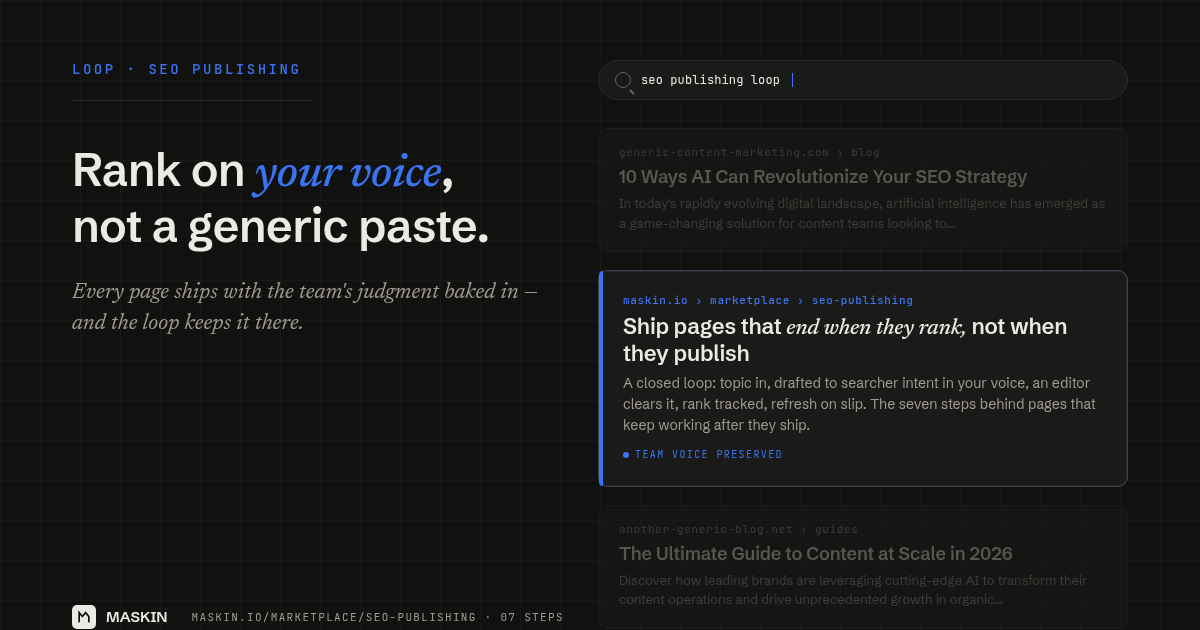
The SEO publishing loop closes on the outcome (a page in the target rank range), not the activity (a Notion doc marked done). Research fires the loop against a query bracket; agents draft to the winning intent; a human gates the intent read and the publish; agents track index and rank until the close condition is met. Every artifact — the query bracket, the draft, the published URL, the rank checks — lives on the same typed graph, so the next page inherits everything the last one learned.
For product teams who own their own growth pages and are done losing weeks to draft in Notion, publish somewhere else, forget who owns rank checks.
Or email ai@maskin.io with subject “Waitlist: SEO publishing loop” and we’ll send it the moment it drops.
What an SEO content loop gets you
The SEO publishing loop closes the gap between “we should write about X” and “X is a live, indexed, snippet-eligible page on our site.” It runs continuously, so weekly audit findings, keyword whitespace, and shipped-in-public changelog entries all end up as real pages without a human touching HTML.
- Keyword insight becomes a shaped brief. A researcher walks the SERP, names the anti-frame the incumbents haven’t claimed, and shapes a brief instead of dumping a keyword list.
- The brief becomes an approved draft. A writer produces markdown against the brief; a human approves before it moves to publish. Override rate is measurable and watched.
- The approved draft becomes a live page. HTML is built with the correct docs shell, JSON-LD schema, canonical, per-page OG image, and interlinking. Sitemap, llms.txt, and llms-full.txt are updated in the same commit.
- The live page gets measured. An analyst tracks indexation, snippet eligibility, and traffic against the bet checkpoints; flagged audit issues (thin content, broken schema, CWV regressions) route back into the loop as tasks.
The result: pages ship on a cadence a human editor can supervise but not personally execute. The wedge over “prompt ChatGPT for a blog post” is the loop shape — approval gate, live registration checklist, measured close — not the generation.
The seven-step SEO content loop the video walks through
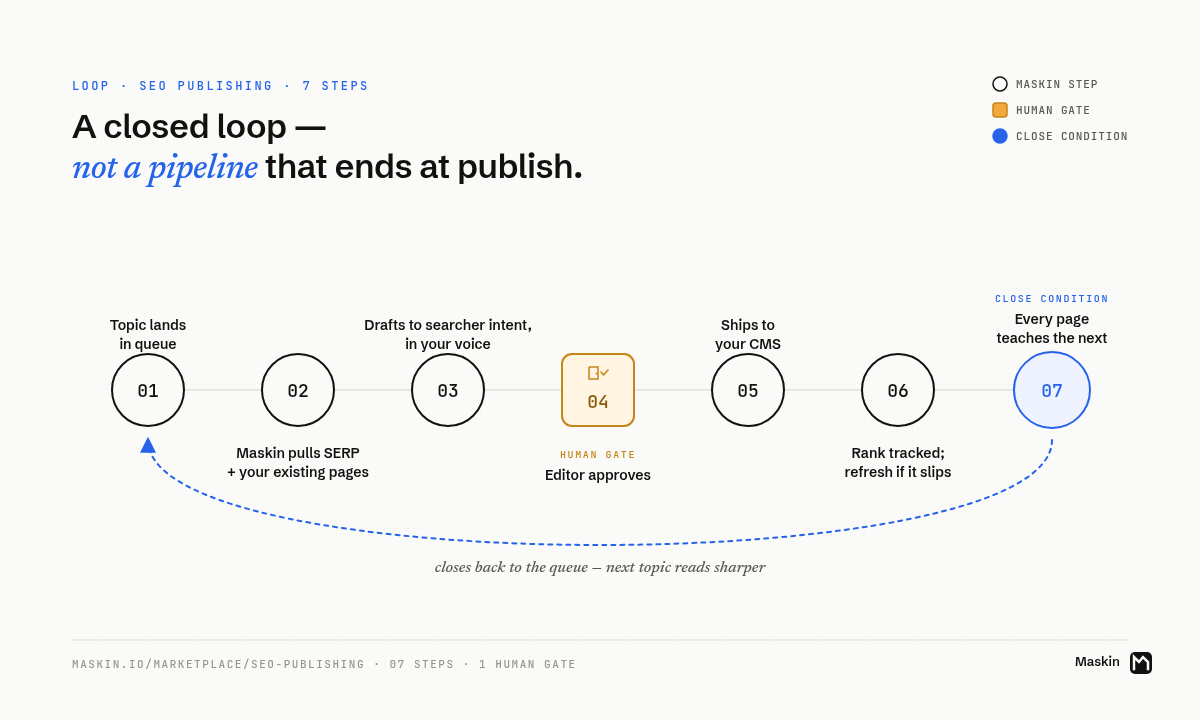
- Signal. A keyword-whitespace insight or a weekly Ubersuggest audit finding fires. The insight becomes a typed object with a testable frame.
- Research. An agent walks the top 10-20 SERP results, extracts the anti-frame, and drafts a brief. A human approves the brief before writing starts.
- Draft. An agent writes the markdown content object against the approved brief, in the site’s voice.
- Human approval. An editor reads the draft, edits inline, and moves status to
published. Override rate is the honest metric that the approval gate is real. - Publish. An agent builds the HTML page with the correct docs shell, JSON-LD, canonical, per-page OG image, interlinking, and registers it in sitemap.xml, docs.js nav, llms.txt, and llms-full.txt in a single commit.
- Measure. An analyst tracks indexation, snippet eligibility, and traffic against the bet’s checkpoints; flagged audit issues fire as tasks routed back to the publisher.
- Close. A page counts as shipped only once it is indexed, snippet-eligible, AND being tracked. Publishing without measurement is noise.
What this loop is built with
Named the same on every loop page so the shape is portable. Below the fold on purpose — the loop is what closes; the primitives are just the parts. Inside a loop listing, agents / MCPs / skills appear as “built with” components of the loop, never as top-level marketplace sections of their own.
Loop
A closed cycle: something fires it (a signal, a schedule, a click), agents do the work, a human gates the taste-sensitive parts, and it ends on a concrete outcome — not on done for now. Every listing on the Marketplace is a loop. Maskin loops carry typed outcomes and verdicts that persist across tools, not recurring workflow execution inside one product.
Agent
A named role a model performs — an SEO analyst, a discovery synthesizer, an outbound writer. Not an AI teammate: a role with a job description, tools it can use, and gates it has to pass before its work leaves the workspace.
MCP
The wire an agent uses to reach the tools your team already uses — the CRM, the docs, the inbox, the analytics. If a human on your team can log in and click, an MCP-native agent can be given the same access under the same gates.
Skill
A packaged capability you attach to an agent — draft a follow-up in our voice, summarize a customer call against our discovery template. Skills are the reusable pieces of judgment your team is already building without realising it.
Full concept map: Agent skills vs MCP vs cursor rules vs workflows explains where each layer belongs.
Programmatic SEO and content operations: why publish this way instead of prompting ChatGPT
Prompting a chat model for a blog post gets you a page. Running the loop gets you a page that’s indexed, snippet-eligible, tracked, and re-audited weekly by an agent that already knows the site’s conventions. The gap between the two shows up around week six, when the chat-model pages are quietly de-indexed for thin content and the loop-shaped pages are pulling traffic that compounds. The override rate at the approval gate is the only honest signal that the loop is real and not theatre.